
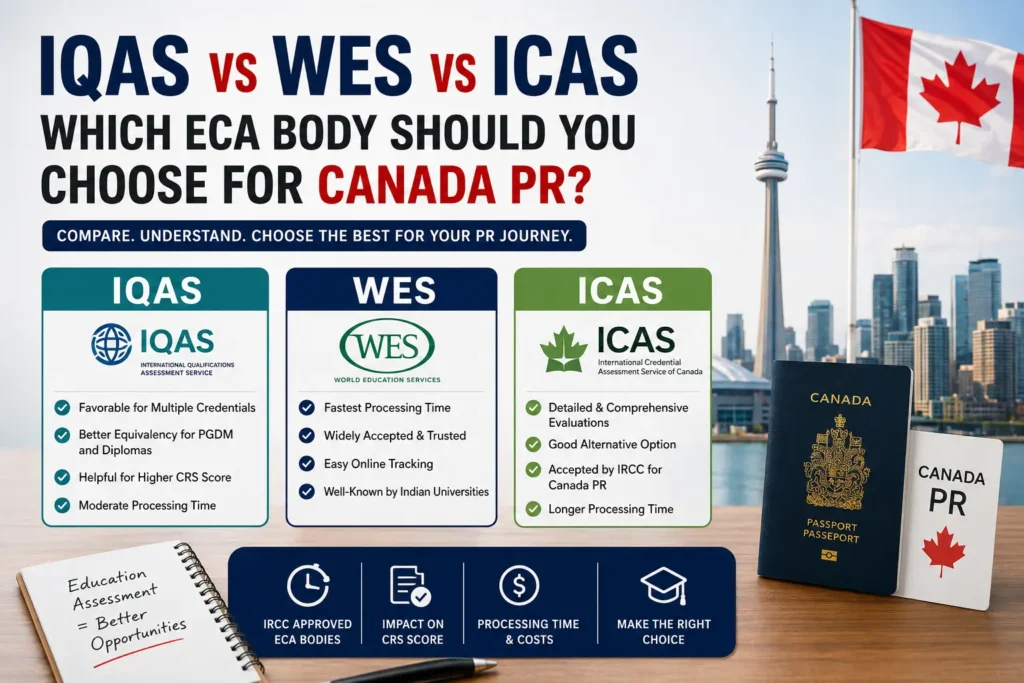
If you are planning to immigrate to Canada through Express Entry, Provincial Nominee Programs (PNPs), or other skilled immigration pathways, obtaining an Educational Credential Assessment (ECA) is one of the most important steps in your journey.
For thousands of applicants from India, choosing the right ECA organization can directly impact processing times, credential recognition, and ultimately the Comprehensive Ranking System (CRS) score used in Canada’s immigration selection process.
Among the designated organizations approved by Immigration, Refugees and Citizenship Canada (IRCC), three names dominate discussions among applicants:
- World Education Services (WES)
- International Qualifications Assessment Service (IQAS)
- International Credential Assessment Service of Canada (ICAS)
While all three organizations are officially recognized for Canada PR applications, they differ significantly in processing timelines, evaluation approaches, customer experience, and how certain academic credentials are assessed.
This guide provides a detailed comparison of IQAS vs WES vs ICAS to help determine which ECA organization may be the best choice for your educational background and immigration goals.
What Is an Educational Credential Assessment (ECA)?
An Educational Credential Assessment is a report that compares your foreign educational qualification with Canadian educational standards.
The ECA confirms:
- Authenticity of educational credentials
- Recognition status of the institution
- Canadian equivalency of degrees and diplomas
- Eligibility for immigration points
Without a valid ECA, applicants educated outside Canada cannot claim education points under Express Entry.
For example:
- A Bachelor of Engineering from India may be evaluated as a Canadian Bachelor’s degree.
- A Master’s degree from India may be assessed as a Canadian Master’s degree.
- Multiple qualifications may qualify for “Two or More Credentials” under Express Entry.
The ECA report remains valid for five years for immigration purposes.
ECA Organizations Approved by IRCC
IRCC currently accepts assessments from designated organizations, including:
- World Education Services (WES)
- International Qualifications Assessment Service (IQAS)
- International Credential Assessment Service of Canada (ICAS)
- Comparative Education Service (CES)
- International Credential Evaluation Service (ICES)
Among these, WES, IQAS, and ICAS remain the most frequently selected by applicants from India.
WES: The Most Popular Choice for Indian Applicants
World Education Services (WES) is arguably the most recognized ECA provider among Indian immigrants.
Thousands of applicants from universities such as:
- University of Mumbai
- Savitribai Phule Pune University
- University of Delhi
- Anna University
- Visvesvaraya Technological University (VTU)
- JNTU Hyderabad
- JNTU Kakinada
- Bangalore University
- Osmania University
- Gujarat Technological University
submit credentials to WES every year.
Advantages of WES
Faster Processing
One of the biggest reasons applicants choose WES is speed.
Once all documents are received and accepted, assessments are often completed significantly faster than competing organizations.
For applicants targeting an upcoming Express Entry draw, this can be a major advantage.
University Familiarity
Most major Indian universities already have established transcript submission processes for WES.
Many institutions:
- Issue WES-specific transcripts
- Send documents electronically
- Understand WES document requirements
This often reduces delays.
Easy Online Tracking
WES offers:
- Real-time status updates
- Online document tracking
- Electronic report delivery
- User-friendly dashboard
Applicants can monitor progress at every stage.
Broad Recognition
WES assessments are accepted by:
- IRCC
- Canadian colleges
- Universities
- Professional licensing bodies
- Employers
Disadvantages of WES
Although popular, WES is not always the best choice.
Many applicants report that:
Certain PGDM Programs Receive Lower Equivalencies
Some postgraduate diplomas and management programs may not receive the evaluation applicants expect.
For example:
- One-year PGDM programs
- Autonomous institution diplomas
- Certain executive management programs
may receive lower equivalencies than anticipated.
Conservative Assessments
Compared to IQAS, WES may sometimes provide more conservative interpretations of:
- Multiple credentials
- Distance education programs
- Hybrid learning qualifications
IQAS: Preferred by Applicants Seeking Maximum CRS Points
The International Qualifications Assessment Service (IQAS) has developed a strong reputation among immigration applicants who hope to maximize educational equivalency outcomes.
Many consultants recommend IQAS for complex educational profiles.
Advantages of IQAS
Often Favourable for Multiple Credentials
Applicants holding:
- Bachelor’s degree + PG Diploma
- Bachelor’s degree + MBA
- Bachelor’s degree + PGDM
often choose IQAS because it has historically provided favorable equivalency outcomes in many cases.
This can help applicants qualify for:
“Two or More Credentials”
or
“Master’s Degree Equivalency”
depending on the educational background.
Strong Reputation for Indian Credentials
IQAS is frequently selected by graduates from:
- Symbiosis International University
- ICFAI institutions
- Autonomous management institutes
- Distance education universities
where applicants hope to achieve stronger recognition.
Potential CRS Advantage
Even a small change in educational equivalency can produce a noticeable CRS increase.
For competitive Express Entry candidates, these additional points can make a significant difference.
Disadvantages of IQAS
Longer Processing Times
The most common complaint about IQAS involves processing speed.
Applicants may experience:
- Extended waiting periods
- Delays during peak immigration seasons
- Slower communication responses
If speed is your top priority, WES generally performs better.
Less Frequent Status Updates
Compared with WES, tracking options may be less detailed.
ICAS: The Reliable Alternative
The International Credential Assessment Service of Canada (ICAS) has been evaluating international credentials for decades.
Although less discussed than WES or IQAS, ICAS remains a respected ECA provider.
Advantages of ICAS
Comprehensive Assessments
ICAS is known for producing detailed evaluation reports.
Many applicants appreciate the depth of analysis provided.
Alternative Evaluation Option
ICAS can be particularly useful when:
- WES does not recognize a specific qualification
- An applicant wants a different interpretation
- Educational pathways are non-traditional
Accepted by IRCC
ICAS reports are fully accepted for:
- Express Entry
- Provincial Nominee Programs
- Immigration applications
Disadvantages of ICAS
Longer Processing Times
ICAS assessments generally take longer than WES.
Applicants should plan accordingly.
Smaller Applicant Community
Because fewer Indian applicants use ICAS, there are:
- Fewer online case studies
- Less university-specific guidance
- Smaller discussion communities
Which ECA Organization Is Best for Indian Universities?
Engineering Graduates
Applicants from:
- Anna University
- VTU
- JNTU Hyderabad
- JNTU Kakinada
- Pune University
- Gujarat Technological University
typically experience smooth processing with WES.
Recommended Option: WES
MBA Holders
For MBA graduates from recognized universities:
- WES performs well
- IQAS may be worth exploring if equivalency outcomes are a concern
Recommended Option: WES or IQAS
PGDM Holders
Graduates from autonomous institutions often compare WES and IQAS carefully.
Recommended Option: IQAS
Distance Education Graduates
Applicants from institutions such as:
- IGNOU
- Annamalai University
- Sikkim Manipal University
- Madurai Kamaraj University
should review current recognition requirements before choosing an ECA body.
Recommended Option: Case-specific assessment
Processing Time Comparison
| ECA Organization | Relative Processing Speed |
|---|---|
| WES | Fastest |
| IQAS | Moderate |
| ICAS | Slower |
Actual timelines vary depending on:
- Document verification
- University response times
- Seasonal application volume
- Transcript delivery
Cost Comparison
All three organizations fall within a similar pricing range.
Additional costs typically include:
- University transcripts
- Courier charges
- Duplicate report fees
- International shipping
Applicants should compare total expenses rather than assessment fees alone.
Does Choosing a Different ECA Organization Increase CRS Score?
Technically, CRS points are awarded based on educational equivalency—not the organization itself.
However, different organizations may occasionally interpret credentials differently.
For example:
One organization may assess a credential as:
“Post-secondary diploma”
while another may assess the same qualification as:
“Bachelor’s degree plus additional credential”
This difference can affect CRS calculations.
That is why many applicants carefully research ECA outcomes before submitting applications.
Final Verdict: WES vs IQAS vs ICAS
Choose WES If:
- You want the fastest assessment.
- You hold a standard Bachelor’s or Master’s degree.
- Your university routinely processes WES transcripts.
- You value strong tracking and customer experience.
Choose IQAS If:
- You hold multiple qualifications.
- You have a PGDM or postgraduate diploma.
- Maximizing CRS points is a priority.
- You can tolerate longer processing times.
Choose ICAS If:
- You need an alternative assessment.
- Your educational background is unique.
- You prefer a detailed evaluation report.
- WES or IQAS are not ideal for your credentials.
For most Indian applicants pursuing Canada PR, WES remains the safest and most widely used option. However, applicants with complex educational backgrounds, postgraduate diplomas, or multiple credentials may benefit from researching IQAS outcomes before making a final decision.
The best ECA organization is not necessarily the fastest one—it is the organization most likely to provide an accurate and favorable assessment of your educational achievements while supporting your long-term immigration goals.