
Marksheet vs. Transcript: Clearing Up the Confusion for Indian Students Going Abroad
If you are an Indian student applying to a Canadian university or any other Western institution, there is a good chance you have come across a requirement asking for a “transcript” and wondered is that the same as my marksheet? The short answer is: not exactly. Understanding the difference can save you from submitting the wrong document and delaying your application.
What Indians Call a “Marksheet”
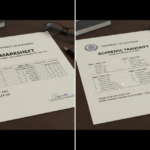
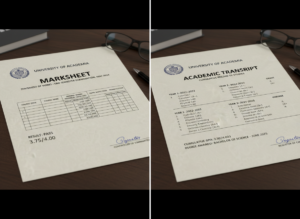
In India, a marksheet (also called a “mark sheet” or “statement of marks”) is a document issued by your school, college, or university at the end of each semester or academic year. It lists the subjects you studied, the marks (scores) you obtained in each subject, and your result — whether you passed or failed.
Most Indian students receive a marksheet after every exam cycle. By the time you finish a three-year bachelor’s degree, you typically have six marksheets one for each semester, or two for each year, depending on your institution’s pattern.
Marksheets in India are usually printed documents issued directly to the student. Some are issued by the university’s exam board, while others come from affiliating bodies like Pune University, Mumbai University, Anna University, and so on.
What Canada and Western Countries Mean by “Transcript”
In Canada, the United States, the UK, Australia, and most other Western countries, a transcript (or “academic transcript”) is a single, comprehensive document that consolidates your entire academic record in one place. It shows:
- All courses/subjects taken across every semester or year
- Grades or marks for each course
- Credit hours or units earned
- Cumulative GPA (Grade Point Average), if applicable
- Degree or diploma awarded, along with the date of completion
Crucially, a transcript is an official document issued directly by the institution’s Registrar’s Office and is typically sent sealed either physically in a sealed envelope or electronically via a secure platform straight to the receiving institution. It is not a document handed to the student to carry around freely, precisely to ensure its authenticity and prevent tampering.
The Core Difference at a Glance
| Feature | Indian Marksheet | Western Transcript |
|---|---|---|
| Coverage | Single exam / semester / year | Entire academic career in one document |
| Issued by | University / Exam board | Registrar’s Office |
| Handed to student? | Yes | Usually sent directly (sealed) |
| Format | Multiple separate documents | Single consolidated document |
| Purpose | Proof of marks in a given period | Official academic record for admissions |
Why the Confusion Happens
The confusion arises because Indian institutions have traditionally never used the word “transcript” that concept simply did not exist in the same form. What Indian universities issued were individual marksheets for each exam cycle, and the entire collection of those marksheets together served the same purpose as a transcript.
When a Canadian admissions office asks for a “transcript,” they are expecting one neat, official document covering all your years of study. When an Indian student hears this, they naturally think of their marksheets and may only send the final year’s marksheet, or may not understand why the university is asking for something separate.
What Should an Indian Student Actually Submit?
Here is the practical guidance:
If a Canadian or Western university asks for a “transcript,” you typically need to provide:
- All your semester/year-wise marksheets the complete set from first semester/year to the last, covering your entire program.
- Ideally, these should be attested or verified by your institution, or sent directly from your university to the foreign institution.
- Many Indian universities now issue a consolidated “Official Transcript” document specifically for this purpose a single document summarizing all semesters. Check with your university’s Registrar or Academic Section if they offer this.
Some universities in India such as IITs, IIMs, Delhi University, and several private universities have formal transcript issuance processes with an associated fee. If yours does, use that. If not, a complete set of certified/attested marksheets is generally accepted as the equivalent.
Always check the specific requirements of the institution you are applying to, as some may explicitly say “all semester marksheets are acceptable,” while others may insist on a single official transcript document.
A Simple Way to Remember It
Think of it this way: in India, you collect one marksheet at a time, like chapters of a book issued one by one. A transcript is the complete book all chapters bound together in a single, officially sealed volume. Western institutions want the whole book, not just the last chapter.
Understanding this distinction early can make your international application process significantly smoother. When in doubt, contact the admissions office of the institution you are applying to they are used to clarifying this for international students and will guide you on what they specifically require.